
We Failed Him Twice
What the sensitive boy needed and didn't get

What I Saw
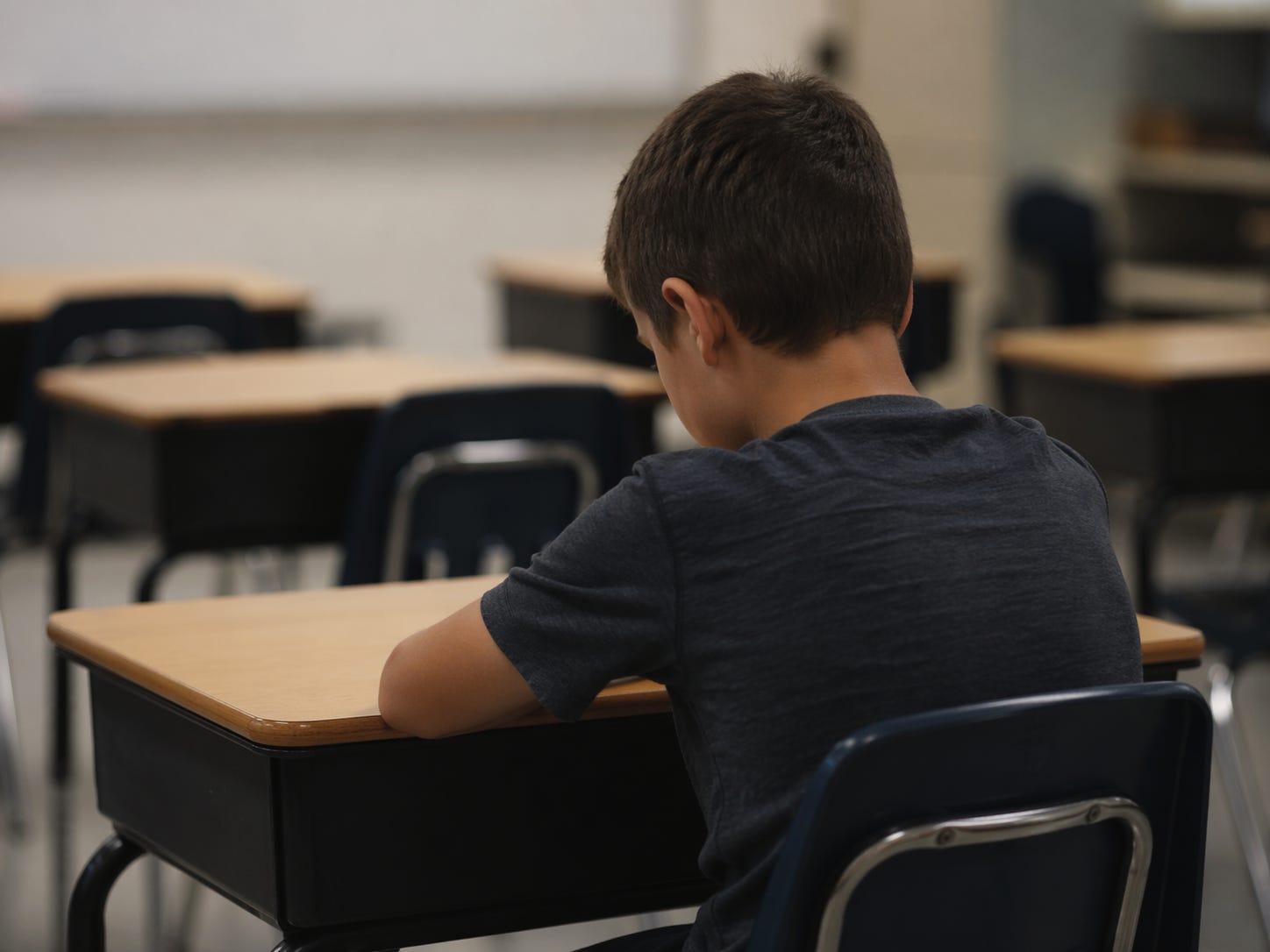
There was a boy in my 4th grade class who made a mistake that followed him for years.
He cried.
I don’t remember what set it off. Some small cruelty, probably, the kind that lands differently on certain kids. What I remember is the fluorescent hum of the classroom going quiet in a way that wasn’t quiet at all. The way his shoulders curved inward, like he was trying to take up less space. And then the sound that followed. I can still hear it. A sing-song rise and fall that boys learn without being taught, aimed with precision at the softest part of him. Not loud, not cruel exactly, just relentless. And the way it didn’t stop the next day, or the day after that.
I still remember his face. The way his jaw went tight trying to hold it, and then didn’t. Not the crying. After a while you stop seeing that and only see what it costs him.
I watched it happen and felt two things at once, and they pulled in opposite directions.
I don’t want that.
I don’t want to lose what he had.
Because I knew what he had. I was the same. I felt things. Not just sadness, but everything. Anger and wonder and injustice and beauty. The feelings came fast and ran close to the surface, and I had been raised to believe that was not a defect.
But 4th grade had other instructions.
What I Learned
The years that followed were not years of suppression. I want to be precise about that. I did not bury the feelings. I learned to read the room. I knew men who had made a different choice, who had closed the door earlier and harder than I did, and seemed, from the outside, to be doing just fine. I understood why. I wasn’t sure they were wrong. But I wasn’t willing to do it. I learned quickly who was safe and who wasn’t, who could be trusted with the real version of me and who would use it. That kind of discretion is its own form of intelligence. Imperfect. Sometimes lonely. But protective in the ways it needed to be.
As I got older and more confident, the guard came down. The more comfortable I became in my own skin, the less I worried about what my emotional openness cost me. By the time I was into my career, I thought I’d figured it out. I felt things and I wasn’t ashamed of it.
I thought that was enough.
I was wrong about what enough meant.
Where I Failed
Early in my career, something was stolen from a colleague’s desk. The violation of it landed on me hard. Some combination of loyalty and justice and righteous anger that felt clean and certain. We had our suspicions. The janitorial staff. Low-wage workers, many of them likely immigrants, people with almost no power in that office and a great deal to lose.
I was certain I was right. And my certainty felt righteous, which is the most dangerous kind of certainty there is.
I wrote a note. Accusatory. Prominent. Left where they would find it.
I almost lost my job.
What I think about now, more than the professional consequence, is the man who likely found that note. I didn’t know his name. I knew his face. He came through our floor every evening, quiet, efficient, never making eye contact with anyone. He had a job to protect. Probably a family. Almost certainly less recourse than anyone else in that building if an accusation stuck. And I aimed my certainty at him.
I had every emotional tool at my disposal. I felt things deeply. I cared about justice. And I used those tools to harm the people who could least afford to absorb the harm.
I was taught better than that. My parents gave me the right values. The failure wasn’t in the formation I received.
Receiving formation is not the same as completing it.
I assumed the work was done. It wasn’t.
What We’re Getting Wrong
This is what we get wrong about boys and emotion.
We tell them the feeling is the problem. It isn’t.
The feeling is information. Raw, real, sometimes overwhelming, always worth something. What boys are almost never taught is what to do with it. How to hold it. How to examine it before acting on it. How to aim it.
The culture offers two options: suppress or detonate. Neither is self-control.
I understand the men who chose suppression. When the cost of feeling in public is that high, closing the door isn’t weakness. It’s adaptation. I know what that interior negotiation feels like, the moment something shifts in your chest and you decide, before it reaches your face, that this room doesn’t get to see it. It’s a boy doing what boys do when the environment teaches its lesson clearly enough. The problem isn’t the choice. The problem is that nobody told him the door could ever open again.
Suppression is avoidance wearing the mask of strength. You cannot govern what you’ve buried. Detonation is suppression’s other side. Feeling stored until it has nowhere to go but out, fast and hot and often at the wrong person. What I did in that office was not the act of a man who felt too much. It was the act of a man who hadn’t yet learned to slow down between feeling and acting. To ask:
Is this true? Is this fair? And who is going to absorb the impact of what I’m about to do?
Those questions don’t come automatically. Someone has to teach them. Someone has to model them. Someone has to stay in the room long enough with a boy, through the anger and the tears and the outsized reactions, to say:
That feeling is real. Now let’s talk about what you do with it.
We are not doing this. We are shaming boys out of feeling entirely, which produces men who are emotionally absent and genuinely don’t understand why. Or we are celebrating emotional openness without pairing it with the harder work of formation.
Emotional openness without self-control isn’t sensitivity. It’s a longer fuse on the same explosion.
The institutions that form boys have been reliable partners in this failure. Churches dressed suppression up as spiritual strength. Coaches built cultures where showing pain was weakness, and some of them genuinely believed they were making boys ready for the world. Schools moved boys along without asking what they were carrying. And fathers, most of them unformed in the same way, passed down the silence they’d inherited, because it was the only thing they had to give.
The boy in my 4th grade class was not punished for feeling too much. He was punished for feeling in front of the wrong people at the wrong moment. What nobody offered him was the wisdom to navigate that. Not to suppress the feeling. To govern it.
What’s Still Unfinished
I don’t know what happened to him. I lost track of him after high school, and I’ve thought about him more than he’d probably believe, wondering whether he closed the door on all of it, or whether someone came along and taught him something different than what that elementary school did. I hope he didn’t let it define him. I hope someone told him what nobody told him then.
Some of you reading this don’t have sons. That doesn’t put you outside this conversation. The formation isn’t finished just because the boyhood is. Most of us are still in it, still finding the places where the feeling outruns the wisdom, still learning to govern what we were never quite taught to feel.
There are parents reading this right now raising boys exactly like him. Exactly like me. Boys who feel things and aren’t yet sure whether that is a gift or a liability. The culture will answer that question one way. You get to answer it another.
The question worth sitting with isn’t whether to raise sons who feel. It’s whether we’re willing to do the harder, slower work, staying in the room through the mess and the emotion and the bathroom notes that almost get us fired, and teaching them not just to feel, but to govern what they feel.
That is not a softer kind of strength.
It is the only kind that lasts.