
The Right Outcome. The Wrong Republic.

Saturday morning, I was sitting at the kitchen table when the notification came through. Four words: Khamenei reported dead. I set my coffee down. I didn’t cheer. I didn’t cry. I sat there for a long moment in something I can only describe as complicated grief — the particular heaviness of getting something you wanted through means you can’t bless.
Iran has been in the background of my entire life. One of my earliest memories of watching the news is the hostage crisis — fifty-two Americans held for 444 days, my parents’ faces tight with something I was too young to name. I grew up understanding Iran as a source of threat and instability. I didn’t romanticize it. I didn’t study it. But I followed it, the way you follow something that never quite leaves the periphery. And in recent months, I couldn’t look away from the protesters — the women who burned their hijabs in the streets, the students who came out by the thousands knowing what was waiting for them. In January alone, estimates suggest the regime killed somewhere between 7,000 and 32,000 of its own citizens to silence them. Whatever I thought I knew about Iran, those people were not abstractions.
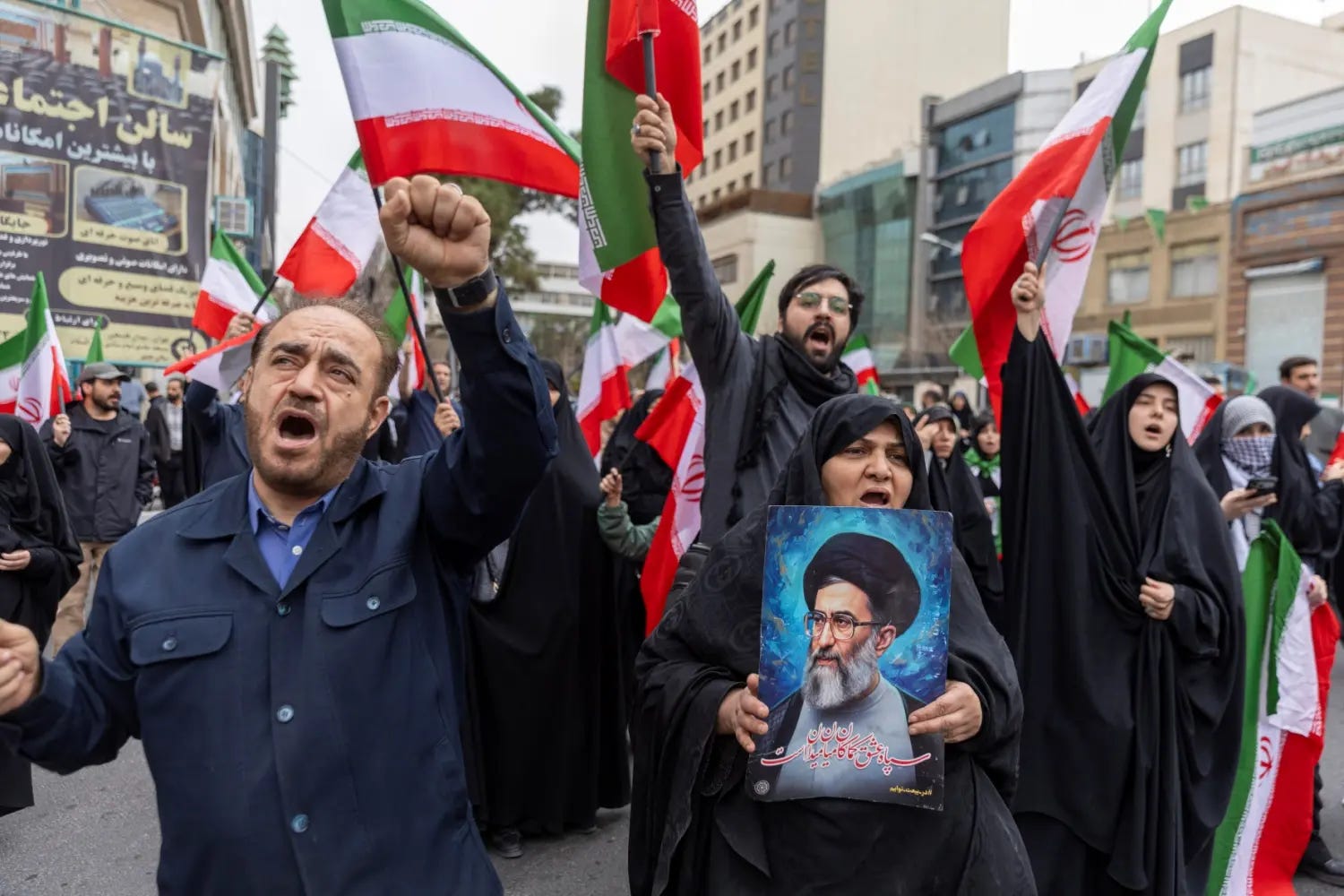
The Islamic Republic has been catastrophic for the Iranian people — for their economy, their freedom, their dignity, their future. On that, I have no ambiguity.
And yet.
The Right Result, The Wrong Process
There is a difference between a good outcome and a righteous one. Between results and process. Between what happened and how it was decided.
One man decided this. Not Congress. Not the American people through their representatives. One man — without a declaration of war, without a constitutional authorization, and, according to the Pentagon’s own closed-door briefings to Congress, without credible evidence that Iran was planning to attack American forces first. The administration claimed Iran was planning a preemptive strike. The Pentagon told Congress there was no intelligence to support that claim.
This is not a partisan observation. It is a constitutional one. The power to take a nation to war was deliberately placed in the hands of Congress by the framers — people who had watched what kings do when war is theirs alone to declare. What happened last weekend was, by any fair reading, un-Constitutional. Not bold. Not decisive. Un-Constitutional.
I want to be honest about my own susceptibility here. There was a flicker — brief, but real — when I thought: maybe this needed to happen. That flicker is exactly what this essay is about.
787 Names
Before we go further, we should sit for a moment with this: as of Tuesday, at least 787 people had been killed in the strikes on Iran, according to the Iranian Red Crescent. That number will rise. Some were military. Some were not. They were inside buildings in Tehran, Isfahan, Qom. Among the dead: an unknown number of girls at an elementary school in Minab, struck on the first day. They had plans for Sunday. Most of them will not be remembered by name in any American news cycle.
I am not willing to walk past that paragraph quickly. The cost of every geopolitical decision is measured first in people, not in strategy. That’s not a liberal or conservative conviction. It’s a human one.
The Peace Prize and the Armada
There is a particular irony worth naming plainly. The man who ordered this strike campaigned as the one who would end foreign wars, not start them. He spoke openly about wanting the Nobel Peace Prize. He told Iranians in January that “help is on the way” — a phrase carrying the warmth of solidarity — and then sent an armada. He said he was “not thrilled” with diplomatic talks that Iran’s own mediators described as having made “substantial” progress, including an Iranian agreement to never develop nuclear weapons.
Deals were possible. They were apparently close. This was a choice.
The Pew and the Constitution
What troubles me most — and I write here as someone formed by the evangelical tradition, not as someone lobbing criticism from outside it — is the response from my own community.
Many American evangelical Christians appear to support this action. And the constitutional question — the one the framers considered so fundamental they embedded it in Article I — seems barely to register. We spent years, rightfully, talking about the rule of law. About institutions. About the importance of process. And now, because the outcome fits, the process disappears.
I have sat in those pews. I have felt the pull of a leader who seemed to be winning for our side. I know how easy it is to baptize an outcome you wanted anyway. That is not a confession I make to score points against my community — it is a confession I make because I don’t trust myself to critique what I haven’t also inhabited.
I want to be fair here. The Iranian protesters who risked their lives in January — and paid for it with them — were themselves reportedly hoping for outside intervention. Hoping for us. There are people in Tehran today who may feel something closer to relief than grief. That is not nothing. Wanting the suffering to stop is not a corrupt impulse, and I won’t pretend the people who supported this action felt nothing but bloodlust. Most of them felt something recognizable: the desire to help. To end tyranny. To be on the right side.
The question I’m raising is not whether those desires were good. They were. The question is whether good desires are sufficient justification for bypassing the constitutional order that protects all of us — including the next person in power whose desires you may not share.
I want to ask my community, with genuine love and not condescension: when did we decide that the ends justify the means? When did “the right result” become sufficient reason to bypass the Constitution we’ve claimed to revere? I’m not asking rhetorically. I’m asking because I think the answer reveals something about where our real faith has been placed — and it may not be where we’d like to think.
There is a version of Christian political engagement that loves power because power produces outcomes. There is another that holds power accountable because people — all of them, including those in Tehran — are made in the image of God. Those two versions are not the same faith, even when they share a pew.
What Republics Lose Quietly
Republics don’t die in a single moment. They erode in the quiet accumulation of times we decided the outcome mattered more than the process. Every time a precedent is broken and no one objects loudly enough, the next break comes easier. The Constitution’s war powers clause wasn’t bureaucratic formality — it was a moral architecture. It was the framers saying: no single person should have this much power over this many lives.
What we lose when we bypass that architecture isn’t just a procedural norm. We lose the principle that power must answer to someone. That even good outcomes don’t sanctify unchecked authority. That the republic belongs to all of us — not to whoever is currently certain they are right.
I grieve this. Not performatively. I grieve it the way you grieve something you can’t easily get back.
The Only Prayer I Have
I do not know how this ends. The conflict is still unfolding. Iran has declared forty days of mourning and launched counterstrikes. The unintended consequences — which are always, always the most consequential part of war — have barely begun to arrive.
What I know is this: the Iranian people deserved to be free. They still do. Freedom that arrives through an unauthorized war, declared by one man who bypassed his own Constitution, will require extraordinary grace and wisdom to become anything durable. I hope it does. I am praying for the people of Iran — for the protesters who risked everything, for the families inside the strike zones, for a future that doesn’t simply trade one kind of suffering for another.
And I am praying for us. For the capacity to want the right things and insist on the right ways. To hold both the outcome and the process accountable. To be people who love liberty enough to defend the mechanisms that protect it — even when, especially when, the person bypassing them is producing results we wanted.
Because the day we stop asking how is the day we’ve already lost something we may not be able to name until it’s gone.
Well said, Will. Events like this bring out all kinds of responses. I recall two things that followed in the aftermath of 9/11, things that are relevant.
First was a theologian saying that the first response of a Christian to the events of 9/11 (specifically the destruction of the World Trade Center) "should be repentance." That's not intuitive, not even natural. The natural response often tends more toward desires for revenge. But repentance is called for because such events reveal to us our own brokenness, our own sinfulness, even as we want to respond in some way that punishes.
And second was a conversation with a fellow church member regarding the US's "shock and awe" response to the attacks of 9/11. He was in a celebratory mood which I both understood but also found I couldn't share. My hope is that we can learn to support such military actions--including what's happening today--as a necessity, but to do so with a heavy heart.