
The Only Sport Coat in a One-Pony Town
How to dress like yourself without becoming a caricature

I walked into a coffee shop in Atlanta wearing what I considered a completely normal outfit: jeans, loafers, an Oxford shirt, and a jacket that had seen enough life to qualify as “broken in.”
Inside, the place had that steady, low hum—half conversation, half concentration. The espresso machine hissed and clattered behind the counter like it was clearing its throat every thirty seconds. A handful of people sat with laptops open, angled toward outlets like sunflowers. Someone laughed too loudly at something on a Zoom call. The air smelled like warm milk and roasted beans, and the whole room carried the faint sense that everyone was both relaxed and mildly behind.
A guy at the counter looked up and grinned. “Man—what are you dressed up for?”
He wasn’t mean. He was just curious in the way people get curious when you’re a little outside the local dress code. Still, I felt it—that tiny moment of exposure. The sense that I’d accidentally announced something about myself I hadn’t meant to say out loud.
And that’s the thing about being “into clothes” outside the menswear capitals. In Manhattan you can dress like you’re headed to a trunk show and no one blinks. In London you can look like a minor character in a novel and people will assume you’re late for a meeting. But in most places—including plenty of places I love—dressing with intention can feel like a declaration.
Are you the kind of person who knows what a soft shoulder is and has opinions about it? Have you ever said “unstructured” and watched someone’s eyes glaze over? Have you owned a pair of shoes long enough to feel emotionally attached to the way the leather creases?
If so, you’re probably surrounded by men who don’t think about clothes that much. This isn’t a judgment. It’s most people. The internet can make a niche feel like the main street, but most men are not debating whether their brown jacket is too close to their other brown jacket. Most men are just trying to get out the door without getting caught in a conversation.
Which is why the question keeps showing up: How do I dress like myself when it makes me stand out? Especially if you’re younger, or you work somewhere casual, or you simply don’t want to be the only clotheshorse in a one-pony town.
It’s not really a clothes question. Not at the center.
It’s a vulnerability question.
A quick humanizing word for the “default uniform”
Before I go any further: I understand why the unofficial dress code exists. The “meh khakis and an ill-fitting polo” thing isn’t a moral failure—it’s a survival strategy.
Most men are optimizing for some combination of comfort, cost, simplicity, and not standing out. They’re busy. They don’t want to think about it. They work in environments where dressing up feels socially risky—like you’re trying too hard, or sending a signal you didn’t mean to send. And plenty of guys have had one bad experience with “dressing up”—a stiff jacket, a cheap suit, the wrong size, the wrong day—and they decided the whole category wasn’t for them.
I get it. I’ve done versions of it too. I still do, depending on the week.
But here’s the thing: default settings are still a choice—you just made it by not choosing.
Why this matters (beyond clothes)
To dress with intention is to risk being misunderstood. You are, in a small way, choosing visibility. You’re coming to terms with who you are—your tastes, your values, your sense of beauty—and you’re doing it in public.
And that’s where confidence and authenticity come in.
Not confidence as performance—confidence as quiet self-possession. The kind that says, “I know who I am today, and I’m not asking the room to approve it.”
Not authenticity as “this is the real me, take it or leave it.” Authenticity as integrity: aligning your outward choices with your inward values, so you can stop obsessing over how you’re being perceived and actually be present with the people in front of you.
Style isn’t a costume. It’s attention made visible.
Which, if you think about it, is really just another way of saying: fit is a form of respect—first for yourself, then for the room.
In a world where so much feels disposable, showing up with intention is a quiet way of contributing to a shared culture of respect.
A confession from the other side of “having a style”
I didn’t always know how to do this.
As a teenager—and honestly well into adulthood—I struggled to find any personal style at all. Part of it was insecurity. Part of it was just not knowing what fit me, literally or metaphorically. But part of it was something else: a contrarian streak.
When I was younger, I carried this half-conscious belief that suits and tailored clothes meant you’d “sold out.” That if you wore a jacket with structure you were announcing you’d become square—like a caricature from the 1960s, choosing respectability over real life. I told myself I wasn’t that guy.
So instead of developing my own taste, I borrowed other people’s cues. Not just in clothing—everywhere. I dressed like whatever group I was trying to belong to, or whatever identity I thought I was supposed to project. It looked like thinking. It was mostly just outsourcing.
Then, about 10–15 years ago, something shifted. Not in a dramatic “new me” way. More like a slow, stubborn realization: if I was going to be contrarian, I should at least be contrarian for my own reasons—not because I was reacting to someone else’s script.
You don’t need a new wardrobe. You need a decision.
An important clarification: I’m not trying to turn you into me
This is something I tell other men all the time: you don’t need to dress like me.
You don’t need the jacket. You don’t need the loafers. You don’t need strong opinions about lapels. What you do need is to wear things that fit and to be purposeful about what you put on—rather than drifting along with the prevailing, unofficial “business casual” dress code of khakis that don’t quite sit right and a polo shirt that looks like it came free from a conference booth.
That uniform is everywhere. And it’s not evil. It’s just…unexamined. Like default settings you never bothered to change.
So here are a few open-hearted thoughts for anyone trying to find their way in the sartorial world—especially if you’re doing it in a place where it might earn you a raised eyebrow.
And a question worth asking, midstream:
What would it look like to dress like you’re honoring the day you’re in?
A field guide for dressing with intention (without being a weirdo about it)
1) Be interesting, not impressive
If your clothes exist mainly to win, they will eventually turn on you. You’ll start dressing for approval, then dressing to avoid disapproval, then dressing in a tight little prison of other people’s reactions.
Instead: dress to feel like yourself on purpose.
The goal isn’t to be best dressed. It’s to be honest dressed.
2) Don’t recruit the room
It’s fine to care about clothes. It’s also fine if other people don’t. The quickest way to make your interest unbearable is to make it evangelistic.
Talk about it the way you’d talk about any hobby you love. Some people will meet you there. Others won’t.
Dress up so you can stop thinking about it—and go be present.
3) Deflect with grace
When someone says, “What are you dressed up for?” try a human answer instead of a defensive one.
“I like how it helps me show up.”
“I had a long week and needed a small win.”
Or, if you want to keep it light: “I’m recovering from my life choices.”
Most comments aren’t attacks. They’re attempts to locate you. You can let people locate you without turning it into a fight.
4) One anchor piece: the navy hopsack jacket
If I had a one-item sermon, it might be this: every man should own a navy hopsack jacket.
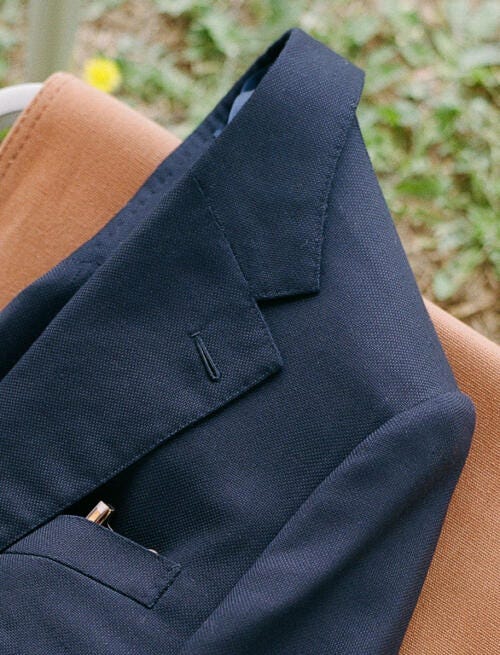
A navy hopsack is the closest thing menswear has to a Swiss Army knife. It’s one of the easiest, most forgiving pieces of clothing you can buy. Dress it up with a tie. Dress it down with denim. Wear it with an OCBD, a polo, or a simple tee. It looks “put together” without looking like you’re auditioning for anything.
And here’s the most Atlanta-specific reason: it’s comfortable in the summer heat. Hopsack breathes. A good one feels like armor that forgot it was armor.
You don’t need a closet full of tailoring. But one jacket that works in real life gets you incredibly far.
5) Every man needs one suit
Even if you never wear a suit to work again, life is still going to ask you to wear one.
Weddings. Funerals. Graduations. Court (hopefully rare). Interviews (still sometimes). The moments where you’re not just showing up—you’re honoring something.
Nothing feels worse than realizing you’re underdressed for an occasion that matters. It’s not just awkward. It can feel disrespectful, even if you didn’t mean it that way.
And those occasions aren’t just personal milestones—they’re communal rituals. They’re the moments where we gather to celebrate, to grieve, to bear witness, to say, in public, this matters. In a culture that can feel increasingly casual about everything, a suit is one simple way to participate with honor—to show up as if your presence is a small form of care.
A few years ago, I was in a grocery store in a suit—nothing dramatic, just a normal suit on a normal day. I was pushing a cart down an aisle when an older Black woman passed by and slowed down, like she was deciding whether to say something. Then she smiled and went out of her way to offer a compliment. She said—plainly, warmly—that she didn’t see many men wearing suits anymore, and it was good to see it.
I’ve thought about that moment more than once. Not because I want credit for wearing a suit in public, but because her comment carried something larger: a recognition that certain forms of respect and care are becoming rare. And when something becomes rare, it starts to feel like a gift when you see it.
Owning one suit is less about fashion and more about preparedness—being ready to meet the serious moments of life with the seriousness they deserve.
6) Comfort is not the enemy—but it’s been promoted to god
Here’s a shift I’ve noticed in recent years: a lot of men have placed comfort at the top of their clothing requirements, and then built an entire wardrobe underneath that one value.
Comfort isn’t bad. But comfort without fit and purpose becomes its own kind of sloppiness—like living on a steady diet of snacks and calling it self-care.
And I think there’s a misunderstanding baked into this. A lot of men think suits and tailored clothes aren’t comfortable. If your reference point is a stiff, poorly made jacket in the wrong size, then yes—tailoring feels like punishment.
But a good suit—well cut, well constructed, properly fitted—is every bit as comfortable as a pair of pajamas. Not because it’s stretchy or sloppy, but because it moves with you the way it was designed to. It gives you ease without giving up shape.
In other words: the problem isn’t tailoring. The problem is bad tailoring.
Comfort isn’t the enemy. But it’s a terrible god.
7) A concrete thing I can’t unsee
Once you notice it, you see it everywhere: couples out on a date night, a wedding, a nice dinner. The woman has clearly taken time—hair, outfit, shoes, the whole posture that says, this matters. And the man is in shorts. Or overly casual jeans and a t-shirt. Or a golf polo that looks like he just left the driving range.
Now—there are a hundred good reasons for this. Maybe he had a long week. Maybe he hates shopping. Maybe nobody ever taught him what fits. Maybe he genuinely didn’t know. I’m not interested in shaming anyone.
But it’s hard not to feel the asymmetry sometimes. One person is signaling, “I’m honoring this moment,” and the other is signaling, “I rolled out of bed.”
And if you love someone, you don’t want your clothes to accidentally communicate indifference.
Fit is a form of respect—first for yourself, then for the room.
8) Learn the difference between standing out and showing off
Standing out is often just a byproduct of being yourself. Showing off is when your outfit requires an audience.
A simple test: if your clothes only make sense when someone notices them, you’re not dressing—you’re performing.
9) Aim for coherence, not “fashion”
Most men don’t need more “style.” They need fewer random inputs.
Coherence looks like:
clothes that fit your body
colors that work together
shoes that match the formality of what you’re wearing
a few repeatable combinations you can trust
That’s not boring. That’s functional confidence.
And if you’re hearing all this as pressure, take a breath—I’ve been the guy who didn’t know what to do, and I’m still learning.
10) Let your style grow up slowly
If you’re still figuring it out, take heart: most people are.
I spent years reacting—trying to signal that I hadn’t “sold out,” trying to avoid looking “square,” borrowing cues from other people instead of building my own preferences.
The goal isn’t to wake up tomorrow and become a new person.
The goal is to stop outsourcing your taste.
Start with fit. Start with one anchor piece. Start with one suit that makes you feel like you can show up to life’s serious moments without apology. Start with the question:
What would I wear if I wanted to respect myself and the people I’m meeting?
That’s not vanity.
That’s maturity.
In the end, dressing well outside the echo chamber is a chance to practice something bigger than clothes: self-knowledge without self-importance.
Wear the jacket. Or don’t. But choose something on purpose. Let your clothes fit your life. Let them make you more yourself—not a character.
And if someone asks what you’re dressed up for, you can smile and tell the truth:
No big reason. I just like showing up like this.