
Mistakenly Seeking Solitude
Why We Think We Want to Be Alone—And Why We’re Usually Wrong

There’s a scholarly paper I can’t stop thinking about. It’s called “Mistakenly Seeking Solitude.” In it, researchers Nicholas Epley and Juliana Schroeder ran a simple experiment: commuters were told either to talk with a stranger on the train or keep to themselves. Almost everyone assumed talking would feel awkward or draining.
But when the experiment ended, the people who had talked to a stranger didn’t just feel fine—they felt happier than those who stayed silent.
Their conclusion was startling in its simplicity:
We routinely underestimate how good human connection is for us, even in tiny doses.
This small insight sits inside a much larger cultural shift. Derek Thompson has argued that America has built “a society optimized for individual autonomy at the cost of communal life.” And the numbers back him up: we spend less time with friends today than at any point in modern history. One national survey found that the percentage of men reporting “no close friends” has increased fivefold since 1990.
We are living in what Thompson calls the Anti-Social Century.
And many of us are mistaking solitude for safety.
The Introversion Misunderstanding
I have friends who say, “I’m too introverted to hang out tonight.”
Sometimes that is absolutely true, especially for friends whose mental health requires real rest, quiet, and recovery.
But introversion often gets misused as a blanket explanation for disengagement. It’s treated as a personality veto: I’m an introvert, therefore I shouldn’t be around people.
That’s not what introversion actually means.
Yes—introverts tend to tire faster in overstimulating environments. Crowds can drain them more quickly. But introversion is about recharging, not about whether someone values relationships. Many introverts are deeply relational, loyal, and present.
What the research actually shows is far simpler:
We often think solitude will leave us feeling better.
And we’re often wrong.
This isn’t universal. For some people, social interaction is truly overwhelming or unsafe. And there are times—real times—when solitude is exactly what we need. But for many of us, withdrawing becomes a habit, one that quietly reduces the very energy we’re trying to protect.
The Friday Gathering That Refuses to Close In on Itself
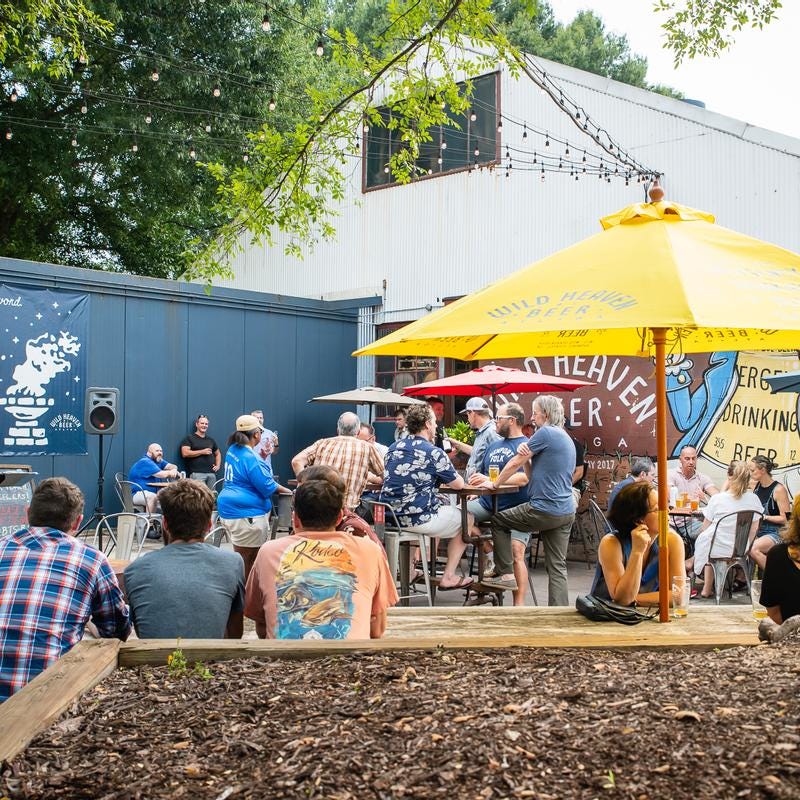
Every Friday at a local brewery, my friend Nick hosts something called Happiest Hour. It’s one of the most meaningful rhythms in my life. No agenda. No pressure. Just a standing invitation: show up if you can.
Two things make this gathering unusual.
First, it’s sustained by men.
In adulthood—especially once kids arrive—women often shoulder the relational load. In our group, though, the men keep friendships alive. Nick organizes. I nudge. Others help. It’s a shared responsibility.
Second, it’s open by design.
Most friend groups narrow over time. Ours expands. Someone brings a coworker. Someone else brings a neighbor. New faces appear and are welcomed immediately.
In a world optimized for autonomy, Happiest Hour is a small rebellion.
A reminder that community rarely forms without intention.
Nearly every week, someone arrives tired or stressed and leaves lighter. Even introverts. Even the exhausted ones. Even the ones who said earlier, “I don’t know if I have it in me tonight.”
It turns out they usually did.
They just didn’t expect to.
The “Opponent” Who Became a Friend
Another story stays with me because it taught me how distance can distort our view of other people.
Fifteen or twenty years ago, I “knew” a guy named Brent —or thought I did. We argued online constantly. I was very conservative at the time; he was very much not. We shared Christian faith, but that often made disagreements feel sharper. I’m sure we didn’t like each other much.
Yet we had never met.
Then one day, by sheer coincidence, we ended up at the same restaurant in Atlanta.
Talking face-to-face changed everything.
Brent wasn’t a bundle of arguments.
He was a person—warm, funny, thoughtful, carrying the weight and joys of real life.
One conversation dissolved years of distance.
That moment taught me something I now believe deeply:
Distance distorts. Presence humanizes.
Now, this isn’t true in every circumstance. Some in-person encounters are genuinely harmful, and I’m not talking about those. But in the broad middle of ordinary relationships—especially those shaped by misunderstanding rather than malice—real connection does what pixels and posts cannot.
The Paradox of Our Anti-Social Era
We live in a culture built to maximize self-sufficiency, convenience, and personal autonomy. We can work alone, shop alone, entertain ourselves alone, and “connect” online without ever encountering another human being.
But autonomy has a shadow side.
The more we retreat, the more persuasive retreat becomes.
Solitude is good—until it becomes our default.
Independence is healthy—until it slowly dismantles the communal scaffolding our lives depend on.
And the absence of relationships quietly reshapes us:
We ruminate more.
Our friend groups shrink.
Our political opponents become caricatures.
We lose perspective.
Our days become more self-referential.
We forget what it feels like to be seen.
Relationships aren’t decorative additions to a meaningful life.
They are the central architecture.
A Gentle Invitation
I’m not asking everyone to attend every gathering.
I’m not prescribing how much social interaction is “right” for you.
And I’m certainly not dismissing real exhaustion or mental health needs.
But I am offering this possibility:
The moment you feel least able to connect might be the moment connection could help the most.
If you’re not sure where to start, here are a few small steps:
Say yes to the next invitation that feels safe.
Text one friend and ask to grab coffee.
Join me at Happiest Hour one Friday—your first drink is on me.
Invite one new person into your circle.
Or simply show up somewhere once a month where you know people will be.
Let yourself be surprised by how good other human beings can be.
Because if the research is right—and if my life is any indication—
we are often mistaken about what solitude can solve.
And we’re often one conversation away from remembering who we are.
I get more kick out of your insights and reflections than I do from the bulletproof lenses of the NYT or the Southern drawl of our AJC.