
Merry Christmas Isn’t a Loyalty Test
On greetings, gatekeeping, and what we’re really defending in December

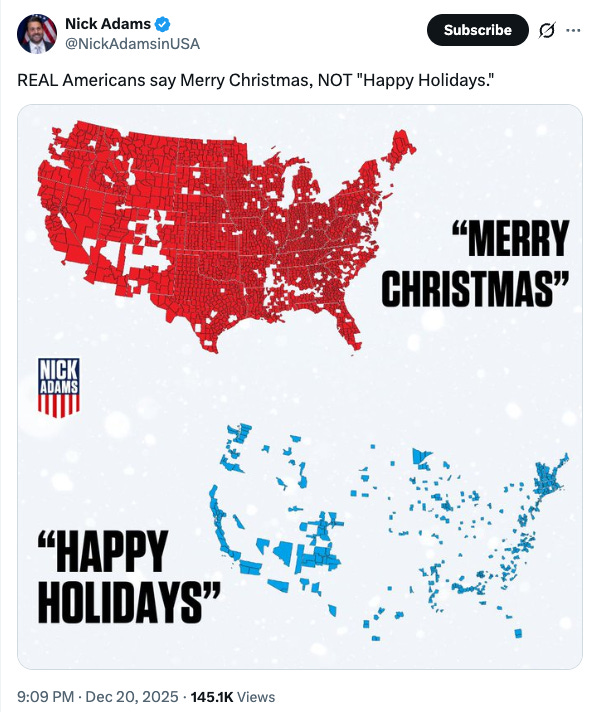
I saw this post from Trump appointee Nick Adams this weekend:
I felt that familiar mix of irritation and sadness.
I grew up in the conservative, evangelical world where this kind of rhetoric gets applause. I remember the “War on Christmas” talking points, the yearly outrage cycles, the breathless segments about Starbucks holiday cups and big-box store signage, the insistence that “Happy Holidays” was some kind of spiritual surrender.
Even then, I never bought it.
I’ve always had a problem with the idea that “Happy Holidays” is an affront to Christians. It never made sense to me that a faith centered on the incarnation of God—on love of neighbor and even enemy—would be so fragile that it could be toppled by a seasonal greeting at Target or a red cup without a nativity scene on it.
Because let’s be honest about what’s packed into a tweet like Adams’s: “Merry Christmas” isn’t being offered as a blessing; it’s being wielded as a boundary marker.
“Real Americans” on one side, everyone else on the other.
That’s not about Jesus. That’s about power and belonging.
When a Greeting Becomes a Loyalty Test
For years now, a certain corner of American Christianity has treated December like a battlefield—coffee cups, store banners, school concerts, mall Santas. Every neutral or inclusive choice becomes fresh evidence of a “War on Christmas.”
Most Christians I know do say “Merry Christmas.” It’s our holiday. It’s tied to our childhood memories, family traditions, church services, and the story we believe about God entering the world.
I’m not interested in shaming anyone out of that. I say “Merry Christmas” all the time.
But there’s a big difference between:
“I joyfully say Merry Christmas because it’s what I celebrate,” and
“You must say Merry Christmas or you’re not a ‘real’ American.”
One is an expression of conviction and joy.
The other is a purity test.
When we turn a seasonal greeting into a loyalty oath, we’re no longer witnessing to our faith; we’re enforcing a kind of cultural conformity. We’re announcing that everyone who doesn’t sound like us is suspect—Jewish, Muslim, secular, religious-but-not-Christian, or just the kid at the cash register trying to keep their job by using the company-approved script.
And notice who ends up on the receiving end of this “courage”: not senators, not CEOs, not cultural elites. It’s retail workers, service staff, newer immigrants, religious minorities. We’re not having a serious theological debate; we’re scolding the person who just bagged our groceries.
If your version of Christian faith feels threatened by a stranger saying “Happy Holidays,” I don’t think the problem is that the culture has become too hostile.
I think the problem is that our faith has been reduced to something small and brittle—more like a brand we’re defending than good news we’re living.
What the Earliest Christians Were Known For
The deeper irony is that the Jesus whose birth we claim to celebrate was not born into a comfortable majority culture that could dictate the greetings. He arrived on the margins, under an occupying empire, outside the halls of power.
The earliest Christians didn’t launch campaigns to make sure the market stalls used the right seasonal language. They quietly cared for the sick, welcomed outsiders, shared their resources, and practiced a way of life that made people curious.
They became known by their love, not their slogans.
So if we want a “real Christian” or “real American” test around Christmas, I’d suggest we start somewhere else—not with what other people say to us, but with what we’re like toward them.
A few questions that cut a lot closer to the heart:
Do people walk away from interacting with us feeling blessed or corrected?
Do our December conversations make exhausted workers feel lighter or heavier?
Do our greetings sound more like invitations or inspections?
A Christian who says “Merry Christmas” with genuine warmth to everyone they meet is not the problem.
A Christian who hears “Happy Holidays” and treats it like an act of aggression might be.
Courage That Looks Like Hospitality
Every December, you’ll hear voices insisting that the front line of courage is rejecting “Happy Holidays” and demanding “Merry Christmas.” Some of them will be pundits; some will be politicians, like Congressman Adams. They’ll tell you that the soul of the nation, maybe even the survival of the church, hangs on which two-word phrase the cashier uses—or what’s printed on your coffee cup.
I don’t buy it.
For Christians, courage in this season looks less like policing other people’s greetings and more like practicing hospitality. It looks like making room at our tables for people who don’t believe what we believe. It looks like noticing the lonely person at the edge of the gathering. It looks like assuming good intent from the person on the other side of the counter instead of turning them into a symbol of everything we think is wrong with America.
You can say “Merry Christmas.”
You can say “Happy Holidays.”
You can say nothing at all and just offer a smile.
The better question is this:
Does the person in front of you feel like a human being, or like a prop in your culture war?
That’s a far more honest test of whether we’re actually living out the story we claim to celebrate.