
Justice Without Victory
What MLK’s “Commitment Card” exposes about our craving to be right—and what reconciliation actually asks of us.

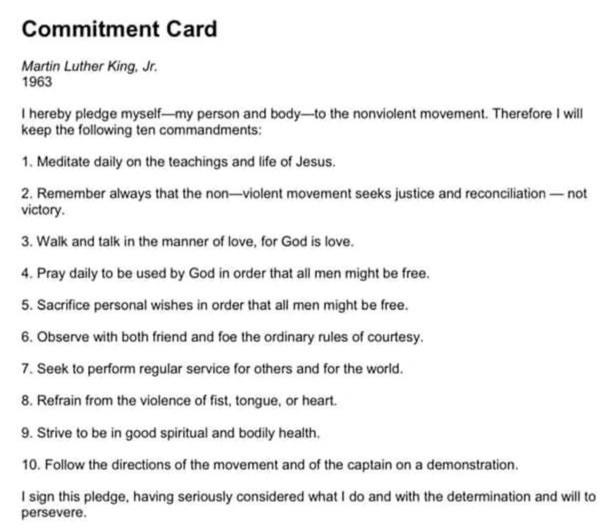
I saw it the way most of us see anything now: in a social media post, late at night, in the quiet that comes after everyone else has gone to sleep. The house was dark. The only light in the room was that familiar blue glow—enough to paint the ceiling, enough to make time disappear. I told myself I was just checking one thing. But my thumb started doing what it’s trained to do: scrolling past outrage, past performances, past the steady invitation to pick a side and despise the other.
Then this image: plain text, no branding, no algorithms trying to seduce me with a fight. A simple heading—“Commitment Card.” A date—1963. Ten “commandments” Martin Luther King Jr. asked ordinary people to pledge themselves to as part of the nonviolent movement.
It didn’t read like a strategy memo.
It read like a rule of life.
And my immediate thought was: we need the ethic and values from this card more than ever now.
Nonviolence wasn’t a vibe. It was formation.
We tend to talk about nonviolence like it’s a tactic—something you adopt because it works. But this card doesn’t feel tactical. It feels spiritual, like it’s preparing people for what conflict does to your soul.
Because if you’re going to confront injustice, you’re going to be tempted—over and over—to become a different kind of person in the process. Hardened. Cruel. Addicted to the rush of winning.
Historically, that’s part of what makes this card so compelling: it was used as a kind of entryway discipline in the Birmingham campaign—something volunteers were asked to commit to, not just admire.
So the card starts where most of our public engagement does not start: prayer, love, health, self-control. It names the violence we normalize—“fist, tongue, or heart”—and refuses to pretend that only fists count.
We don’t call the contempt we cultivate “violence.”
But the fruit looks familiar.
The line I can’t stop thinking about
One line on the card feels like the hinge of everything:
“Remember always that the nonviolent movement seeks justice and reconciliation—not victory.”
Not victory.
That phrase hits me in the chest because it names what so much of our public life is built on: victory. Total victory. The win that comes with a loser. The win that requires humiliation. The win that tastes like dominance.
And if I’m honest, it names something in me too.
For decades, I was dead set on being right—often to the exclusion of loving others. Not just “right” in the sense of accurate, but right in the way that makes you feel superior. Right in the way that lets you dismiss someone instead of understanding them. Right in the way that turns people into problems to solve rather than neighbors to love.
I didn’t stumble into that posture accidentally. I was trained into it. Evangelical apologetics taught me to spot logical inconsistencies like a sport. Dinner table debates taught me that quick thinking was a kind of strength. I got good at winning arguments—so good that I sometimes confused winning with wisdom, and correctness with love. And if I’m honest, I still feel the urge to debate—often—especially when I’m convinced I’m right.
There’s a version of “being right” that is really just a baptized form of pride.
And I’ve lived there.
Reconciliation is not weakness. It’s an ambition.
When people hear “reconciliation,” they often hear softness. They hear compromise. They hear a call to pretend the harm wasn’t real.
But reconciliation—real reconciliation—isn’t denial. It’s not pretending. It’s not patting each other on the back and moving on because naming the truth feels too costly.
Desmond Tutu put it with a clarity that doesn’t let anyone hide:
“True reconciliation exposes the awfulness… only an honest confrontation with reality can bring real healing.”
—Desmond Tutu
That’s the part we forget. Reconciliation doesn’t avoid the truth—it walks straight into it. It may even make things feel worse before they get better, because truth has a way of pulling buried pain into the light.
And here’s the fairness check: I understand why “reconciliation” can sound dangerous to people who have been harmed. If reconciliation becomes a shortcut—if it becomes a demand for quick peace, cheap forgiveness, or silence—it doesn’t heal anything. It just protects comfort and preserves power.
But that’s exactly why Tutu’s framing matters. Real reconciliation doesn’t erase accountability. It requires honesty. It forces the wrong into the open. It’s not the opposite of justice. It’s justice that refuses to become cruelty.
And there’s beauty in that. Reconciliation is an audacious bet—against all the cynicism in us—that people are more than their worst moment, and that truth can lead to healing without requiring humiliation.
Victory has a hidden cost
Victory is seductive because it feels clean. It draws a bright line: good guys and bad guys, heroes and villains, the righteous and the irredeemable. It offers a moral shortcut: if we can just defeat them, the world will be set right.
But victory has a cost—one we rarely name until it’s too late.
It trains you to crave the dunk more than the truth.
It turns disagreement into disgust.
It makes contempt feel like courage.
It baptizes humiliation as “accountability.”
And eventually, it makes it impossible to live in a pluralistic society without viewing half your neighbors as enemies.
King understood something we seem determined to forget: you can’t build a beloved community with the tools of humiliation.
And here’s one of the hottest lines in this whole essay, so let me say it carefully: you can’t follow Jesus while feeding on contempt.
If that feels sharp, it’s because I’m saying it to myself first. I know how easy it is to baptize disgust as discernment.
The violence of the tongue is now our daily liturgy
One of the most prophetic lines on the card is this:
“Refrain from the violence of fist, tongue, or heart.”
Our platforms are basically built to monetize the tongue and inflame the heart. Speed over care. Certainty over curiosity. Outrage over understanding.
Even truth-telling can become violent when it’s untethered from love.
You can be correct and still cruel.
You can be accurate and still corrosive.
You can “win” and still lose something in yourself.
I think a lot of us—myself included—have used “truth” as a permission slip to stop being kind.
And for some of you reading this, the issue isn’t that you like debate. It’s that you’ve been on the receiving end of someone else’s need to win—at the dinner table, in a marriage, in a church, in a group chat—and you still carry the bruise. I see you.
What would it look like to seek justice without seeking victory?
This is the question the card puts in front of me.
Not: Do you care about justice? Most of us do, in our own way.
But: What are you becoming as you pursue it?
What habits are you practicing? What spirit are you cultivating? What fruit is your life producing?
Because the card suggests something that sounds almost offensive to modern ears: if you want to confront injustice, you may need to train yourself first. Not to become passive—but to become disciplined.
A small practice for the next 30 days
I’m not interested in romanticizing 1963, or pretending the civil rights movement was simple, clean, or universally embraced. It wasn’t.
But I am interested in the spiritual seriousness of this card—the way it assumes that love is not a mood but a practice.
So here’s a small invitation—not for perfection, but for formation.
For the next 30 days:
Before you post, ask: am I seeking understanding—or victory?
Refuse the dunk. If your point requires humiliation, choose a different point—or a different tone.
Practice courtesy with friend and foe—not because they earned it, but because you refuse to become someone you don’t respect.
Pray daily for one person you’re tempted to despise. (Yes, really.)
Do one quiet act of service each week—local, unglamorous, human.
None of this solves the world.
But it might keep your soul from shrinking.
Closing question
If the nonviolent movement sought justice and reconciliation—not victory, what would change about the way you argue, post, vote, or speak about the people you disagree with?
And more personally:
Which do you want more—being right, or being whole?
Oh my Lord, this is a high call. Thank you. I need this practice and I pray I will pause, and consider before speaking, posting or going down the rabbit hole of feeling right.
Ouch.
That struck home, for sure.
I spent a lot of the last week, in my mind and in a couple conversations, laboring to correct what I saw as "major doctrinal error"...