
Did God Pick the Winning Team?
What athletes reveal about how we misunderstand God and success

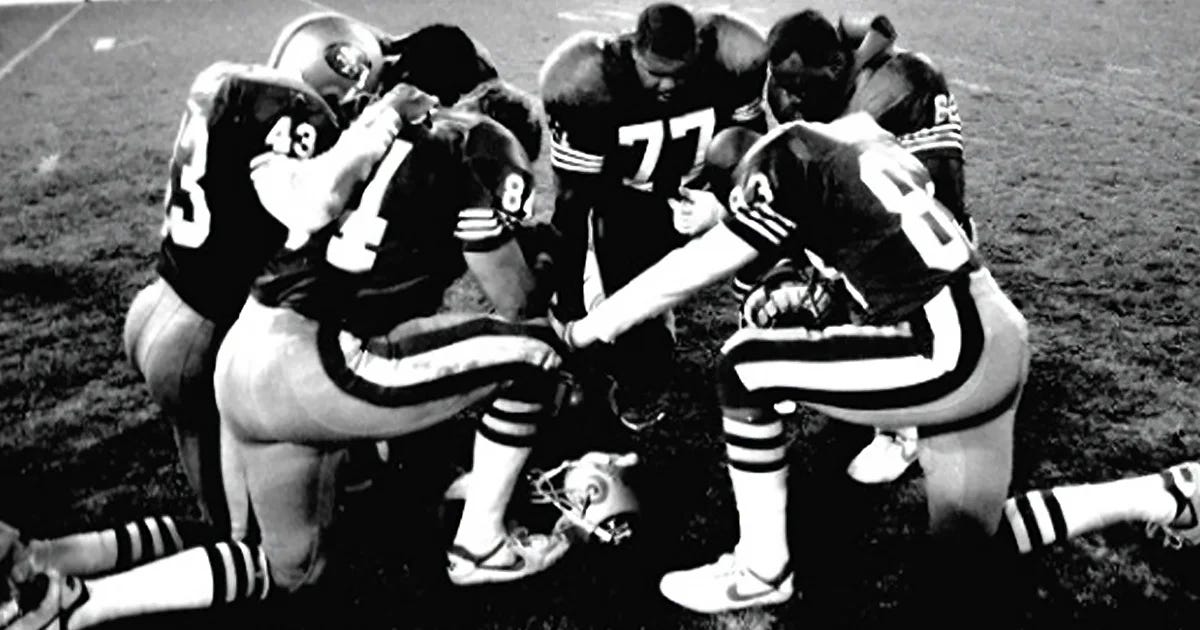
The confetti hadn’t even settled.
He was still breathing hard, shoulder pads rising and falling under the glare of stadium lights. A reporter shoved a microphone toward his face.
“First and foremost, I want to thank my Lord and Savior Jesus Christ for this victory.”
The crowd roared.
And somewhere, on the other sideline, another Christian bowed his head in a quiet locker room.
I’ve heard some version of that line my entire life. Super Bowls. National championships. High school gyms that smelled faintly of rubber floors and popcorn. Public gratitude. Bold faith. God named in the middle of cultural spectacle.
For years, I admired it.
Now, I’m not so sure.
Because I keep coming back to one uncomfortable question:
What exactly are we saying about God when we credit Him with the win?
And I want to be clear about the good I’m trying to protect here: honesty about providence—the humility to speak truthfully about what God does and doesn’t promise, without turning Him into an explanation for outcomes we happen to like.
Gratitude Is Not the Same as Causation
Gratitude is beautiful. I don’t question the sincerity of the athlete who says it. In a world addicted to self-congratulation, acknowledging dependence can be an act of humility.
And I can understand why an athlete reaches for God-language in that moment. When you’ve trained for years, when the stakes are enormous, when the adrenaline is still burning and the mic is suddenly in your face, you grab the deepest words you know.
But humility can quietly morph into something else.
There’s a difference between:
“God gave me the strength to compete.”
and
“God gave us this victory.”
The first honors dependence.
The second suggests preference.
And preference implies something we rarely say out loud:
God chose us over them.
If that’s true, then what are we saying about the team that lost?
Were their prayers weaker?
Their faith thinner?
Their obedience less complete?
If God is choosing sides in championship games, we’ve reduced Him to a mascot—a cosmic sponsor stitched onto our jerseys.
That may sound harsh. But I’m not trying to shame the athlete on the stage; I’m trying to name the theology hiding inside our applause.
Providence Is Not Performance Enhancement
Christians believe in providence. I do. I believe God is active in the world. I believe prayer matters.
But providence is not the same thing as performance enhancement.
Jesus never promised competitive advantage.
He promised suffering.
He promised presence.
He promised a cross before a crown.
The New Testament vision of victory looks suspiciously unlike a trophy ceremony.
So when we equate winning with divine favor, we may be importing a theology of success that Scripture itself never guarantees.
This Isn’t Just About Sports
And here’s where this stops being about sports.
Athletes are simply more visible versions of what many of us do quietly.
When the deal closes, we thank God for the contract.
When the promotion comes, we call it blessing.
When our political candidate wins, we talk about God “moving.”
But when we lose?
We rarely say God chose differently.
We’re quick to baptize outcomes we like.
Slow to interpret outcomes we don’t.
Maybe the deeper problem isn’t athletes thanking God.
Maybe it’s our reflex to equate success with approval.
I’m Not Above This
I’m not above this.
I’ve felt the quiet rush of assuming that a good result meant God was “on my side.” I’ve interpreted momentum as endorsement.
It’s intoxicating.
Winning feels like affirmation. Losing feels like doubt.
But the Gospel disrupts that entire equation.
The central symbol of our faith is not a podium.
It’s a cross.
And on that Friday, it certainly did not look like God had picked the winning side.
What If God Cares About More Than the Scoreboard?
What if God’s primary concern in a game isn’t the scoreboard, but the soul?
What if He cares more about integrity in competition than the outcome of competition?
What if both locker rooms are equally under His gaze—equally loved, equally formed?
That would mean divine faithfulness is not measured in points.
It would mean the losing quarterback can thank God just as honestly as the MVP.
Not because God handed him the trophy.
But because God was present in the trial.
I Don’t Want Less Public Faith
I don’t want less public faith in sports.
I want clearer faith.
Faith that says:
“God gave me breath.”
“God gave me discipline.”
“God gave me teammates.”
But stops short of implying:
“God picked us.”
Because if we’re not careful, we start to treat God like He’s running a fantasy league.
And I get why that framing is tempting—winning is loud, losing is lonely, and we all want our story to mean something.
But God is not a prop in our meaning-making.
Maybe the most faithful move is simply to be more precise.
A Better Testimony
Maybe the more subversive testimony after the game would sound like this:
“Win or lose, Christ is Lord.”
That kind of faith doesn’t turn God into a mascot.
It refuses to make Him small.
And it’s something both sidelines could say amen to.
So here’s my question for all of us—athletes, fans, and the rest of us who translate success into spirituality:
What would it sound like if our faith thanked God for His presence instead of assuming His preference?