
Comfort Is King — Until He Makes You Wear Pajamas to the Meeting
How men confused “easy” with “good,” and how tailoring quietly fixes it

The thread was already hot when I found it.
The room was dim, the TV was doing its background-noise job, and the blue glow of my phone made everything feel a little too bright—like the internet always does at night.
I was half-watching a show I didn’t care about, half-paying attention to my phone, when the menswear subreddit delivered one of those deceptively small questions that’s actually a window into everything:
“What are better ‘business casual’ alternatives to Lululemon ABC pants?”
I clicked in. Guys were doing what guys do—trying to be helpful without making it weird. Links. Fit notes. “Size up.” “Don’t size up.” The usual.
I read the question again and thought, We’re really doing this, huh?
So I replied, pretty politely: Those pants are comfortable, but they’re casual. Not business casual.
For about ninety seconds, nothing happened. Then the internet did what it does.
“that is fair hate, but what is a good alternative”
“You’d have to be a moron to think ABCs aren’t business casual lol”
“This type of athleisure tech pant is one of the most common things worn on a daily basis in offices all over America, it’s pretty firmly established as business casual.”
I couldn’t help myself—I typed back:
“I’ll accept ‘moron’ as feedback. My only point is: tech pants are casual, even if they’re common in offices.”
Then I set my phone down and felt that weird, familiar moment where you realize you’re not in a debate—you’re watching a cultural shift happen in real time.
Because here’s the truth: it’s not just that “business casual” has gotten looser. It’s that a lot of men have skipped the category entirely. They’re not choosing business casual over formal.
They’re choosing comfort over everything.
And once comfort becomes king, it doesn’t stop at “stretch trousers and a quarter-zip.”
It keeps going.
I’m not a Lululemon guy—never have been—but I understand why those pants have become a uniform: decision fatigue is real, and a lot of men are just trying to get through the day.
To me, business casual is clothing that can survive a surprise meeting—without you feeling like you need to apologize for your outfit.
A high armhole isn’t “fancy”—it’s what lets you move without the jacket pulling across your back like a seatbelt.
Somewhere along the way, comfort stopped being a preference and became the cultural virtue—the thing that outranks taste, dignity, and even presence.
And that’s the part that interests me. Not because I want to resurrect some golden age where every man wore a tie to buy groceries—but because I think showing up well is a small way of honoring people. It’s a quiet signal that says, you matter enough for me to be present.
The Comfort Logic (Taken to Its Natural Conclusion)
Let’s just walk the argument all the way out, because satire is sometimes the fastest way to tell the truth.
If comfort is king…
…then why stop at “business casual athleisure”?
Why not go all the way?
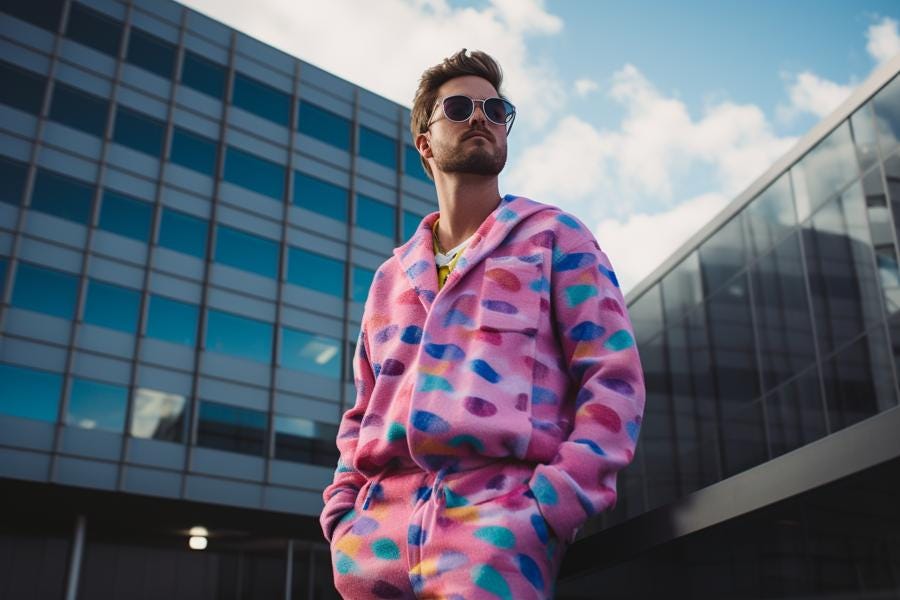
If comfort is king, why not wear pajamas to work?
And I don’t mean the tasteful kind, either. Not the “I bought these in a boutique and call them loungewear” pajamas. I mean the real ones. The soft, faded kind with the waistband that has survived a thousand nights of snacks and late Netflix.
If comfort is king, why not wear slippers to the quarterly review?
Why not bring a blanket to your 10:00 a.m. one-on-one? (You can call it a “throw” if you want to keep a shred of dignity.)
Why not show up to a client meeting in a bathrobe, carrying a mug that says World’s Okayest Adult?
If comfort is king, then the rational end state of menswear is not athleisure.
It’s bedding.
And at that point it’s not comfort—it’s retreat.
At a certain point, we’re not buying clothes—we’re buying permission to emotionally clock out.
You can picture the new brands now:
Boardroom Pajama Set™
Wrinkle-resistant flannel. Investor-ready piping. Hidden pocket for your phone and your last remaining ambition.
The Executive Snuggie™
Now in charcoal. For the man who wants to look like leadership, but feel like a nap.
I’m exaggerating. But not by much.
Because the real point isn’t that comfort is bad.
It’s that comfort is an unreliable god.
Comfort always asks for one more concession.
One more “who cares.”
One more “this is fine.”
And slowly, without meaning to, a man can stop asking a very human question:
What does my presence communicate?
A GQ Writer Tried the Opposite (and Accidentally Proved the Point)
A recent GQ essay—“I Wore a Suit Every Day for a Month. Here’s What I Learned”—is one of the better takes I’ve read on this whole question. (GQ link)
Two lines from that piece stuck with me:
“But ultimately, we get dressed for ourselves.”
“We men are lost, worshipping at the false idol of comfort.”
He’s not praising formality. He’s naming something I’ve felt too: clothes can either wake you up—or give you permission to disappear.
The Surprise: A Suit Can Be More Comfortable Than Your “Comfort Clothes”
Here’s the part that feels almost offensive to modern ears:
A good suit—properly made, properly fit—can be incredibly comfortable.
Not “I can tolerate it” comfortable.
Not “I’ll endure this for the photos” comfortable.
I mean: you forget you’re wearing it comfortable.
Because most of what people call “uncomfortable” about tailored clothing isn’t actually about tailoring.
It’s about bad fit.
A jacket is uncomfortable when:
the armholes are cut too low so every movement pulls the body of the coat,
the shoulders are too narrow so you feel trapped,
the chest is too tight so you breathe like you’re negotiating with your own ribcage.
Trousers are uncomfortable when:
the rise is wrong so the waistband is constantly reminding you it exists,
the seat is too tight so you sit like you’re bracing for impact,
the thigh is too narrow so you walk like you lost a bet.
But when those things are right?
A jacket becomes a soft frame. Not a cage.
Trousers become structure with ease—like the difference between a good chair and a beanbag. A beanbag feels nice for five minutes. A good chair holds you up for hours.
And the fabrics matter too. A lot of men think “dress clothes” means stiff, shiny, scratchy, corporate armor.
But good wool—especially in the right weight—doesn’t feel like armor. It feels like air with intention. A breathable, unlined hopsack jacket in spring or summer is the perfect example: it hangs with structure, but it wears like you’ve got nothing on.
Real comfort isn’t “nothing touches me.”
Real comfort is support without restriction.
What We’re Really Talking About (It’s Not Just Pants)
I don’t think most men are consciously choosing uglier clothes. I think they’re choosing relief.
Relief from expectation.
Relief from judgment.
Relief from the feeling that they’re supposed to be “on” all the time.
And the culture quietly reinforces it: “You’ve earned comfort.” “You deserve ease.” “Life is hard—don’t make it harder.”
That’s all true.
But there’s a difference between ease and erosion.
At some point, “comfort first” becomes a story we tell ourselves to justify something else:
I don’t want to think.
I don’t want to try.
I don’t want to be seen.
And I want to be careful here. Because this isn’t a moral lecture.
Some men are genuinely overwhelmed. Some are depressed. Some are grieving. Some are buried under stress and responsibility and the low-grade anxiety of modern life.
If that’s you, I’m not here to scold you into a blazer.
I’m just saying: the goal isn’t to perform sophistication.
The goal is to recover a small, quiet form of self-respect.
And maybe—this matters too—a small, quiet respect for other people.
Because clothes are never just about you. Not entirely.
They signal care. They signal attention. They signal presence.
They can say: I showed up for this.
And if I’m being honest, I’ve had seasons where my default wasn’t sweatpants—it was indifference. Same impulse, better fabric.
A Different Definition of Comfort
We’ve defined comfort as “maximum softness with minimum thought.”
But there’s another kind:
Comfort as confidence.
Comfort as being at ease in your own skin.
Comfort as having a few pieces that fit so well you stop adjusting yourself all day.
There’s a reason men who start wearing well often don’t go back—not because they’ve become vain, but because something subtle changes:
They stop feeling sloppy.
They stop feeling like they’re apologizing for themselves.
They feel… finished.
Not flashy.
Finished.
Five Ways to Dress Better Without Giving Up Comfort
If you want the practical version—no manifesto, no guilt—here are a few moves that keep comfort and recover taste.
Start with trousers that actually fit.
Not skinny. Not baggy. Just right in the seat and thigh. You’ll be shocked how much better everything else looks.Upgrade your “easy shirt.”
A knit polo, an OCBD, or a good tee with structure can feel just as comfortable as the usual rotation—but it looks intentional.Choose unstructured jackets.
Soft shoulder, less padding, lighter construction. The right sport coat feels more like a cardigan than a costume.Stop buying the lie that “stretch” is the only path to comfort.
Stretch helps. But fit helps more.Get one thing tailored.
Just one. Not because you’re becoming a new person—because you’re giving your body clothes that actually match it.
None of this requires you to be a “menswear guy.”
It just requires you to believe something basic:
You can be comfortable without checking out.
Closing Grace
I’m not trying to bring back some golden age where every man wore a tie to buy groceries.
I’m just wondering if we’ve confused comfort with retreat.
If comfort is the only thing we’re after, the end of the road isn’t freedom.
It’s disappearing.
And maybe the better question isn’t, “What’s the most comfortable thing I can wear?”
Maybe it’s: What’s the most honest version of me I can show up as today—without pretending, and without quitting?
Because the strange gift of good clothing—good tailoring, good fit, good fabric—is that it can make you feel more at home in your own life.
Not less comfortable.
More.