
A Christianity Mostly About Winning
Christian Nationalism calls itself Christian. But look at where Jesus started.

The Name I Filed Away
It was a fall evening, cold enough that we’d pulled our chairs close to the fire. A group of us — eight or ten guys, most of us slightly right of center, a few more libertarian, one or two who leaned left — gathered the way we did every few weeks on a friend’s back deck. Craft beer, fire pit, the kind of conversation that moves without an agenda from theology to economics to politics and back again.
One of the guys that night had spent time in circles most of us hadn’t. More theologically embedded, more familiar with the edges of the Reformed world. He wasn’t alarmed exactly — but he wasn’t dismissing it either. He started talking about a movement sometimes called dominionism: the idea that Christians are called to take dominion over every sphere of society, including government. He mentioned names. One of them was Doug Wilson.
Someone changed the subject. I reached for my beer. Wilson’s name went into the same mental folder as every other fringe figure I’d catalogued and forgotten — interesting for a moment, dangerous in theory, too extreme to ever really matter.
Around the same time, Wilson’s name was surfacing in the church I attended — a different context, a different kind of dispute, the same conclusion from me. Fringe. Contained. Not worth the urgency.
I filed the name away and went back to my beer.
The Man I’d Written Off
It was late. I was sitting with my laptop, following a thread of recommendations the algorithm had decided I needed to see, and eventually I landed on a YouTube video of Doug Wilson — pastor, author, self-described Christian nationalist — holding court on what America should become.
I had known about Wilson for the better part of two decades. He runs Christ Church in Moscow, Idaho. He believes women shouldn’t vote. He has defended the institution of Southern slavery as something that, in his telling, had its “tender mercies.” He has written that a Christian republic should formally affirm the Lordship of Jesus Christ in its laws and institutions. I had never been confused about what he believed — I viewed him as an extremist, a dominionist, a figure whose theology led somewhere genuinely dangerous. What I had filed away, for most of my adult life, was the question of whether any of it would matter.
But that night something had shifted, and I could feel it. Wilson wasn’t talking to a church basement. He was being interviewed like a mainstream intellectual. His books were being cited. His arguments were being engaged seriously. And then I remembered: in February 2026, Doug Wilson stood at a podium inside the Pentagon, invited there personally by the Secretary of Defense, Pete Hegseth — a man who calls Wilson a mentor. The photo of the two of them, Hegseth’s hand on Wilson’s shoulder, circulated across the internet with the caption: “We are One Nation Under God.”
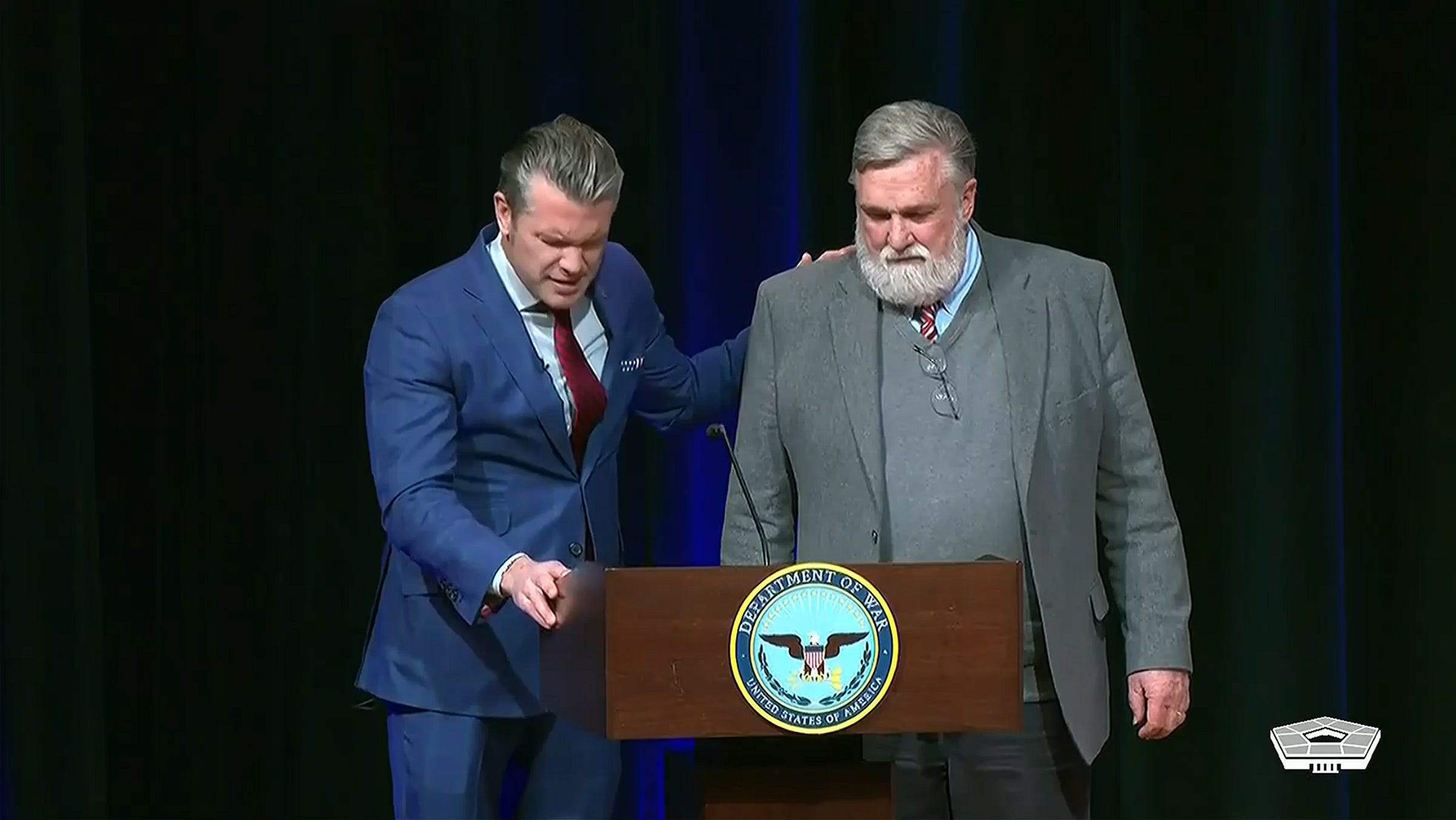
The man I had spent twenty years cataloguing as dangerous — and irrelevant — was now preaching to the American military.
I thought about that evening on the deck. I thought about my friend who hadn’t quite dismissed it the way the rest of us had. I thought about what I owed him.
I Owe a Friend an Apology
What I missed wasn’t the ideology. I understood what Wilson believed, and I called it extreme. What I missed was the infrastructure. The classical Christian schools. The publishing houses. The podcasts. The slow, generational work of building a movement that didn’t need to win an election in 2005 because it was planting seeds for 2025.
I assumed the radicalism of the ideas would keep them contained. It didn’t occur to me that the extremity might have been part of the appeal.
My friend on that deck — the one who’d spent time in those circles, who brought up Wilson’s name while the rest of us nodded and reached for our beers — wasn’t quite as certain as I was. I didn’t register that at the time. I should have.
So before I say anything critical about Christian Nationalism, I want to say this: I was the person who got the ideology right and the trajectory wrong. I understood what Wilson believed. I called it extreme. And then I assumed extreme meant contained. I was wrong about that. And my friend saw it before I did.
What We’re Actually Talking About
I’m not saying Christians shouldn’t vote. Shouldn’t serve in government. Shouldn’t care about schools, courts, or policy. That’s not Christian Nationalism. That’s citizenship — sometimes wise, sometimes messy, often necessary.
Christian Nationalism is something more specific: a political theology that fuses Christian identity with national identity and treats state power as the primary instrument for making the nation Christian. Its more explicit proponents have called for legislation enshrining the Ten Commandments as the nation’s foundational law, laws against public blasphemy, and the formal affirmation of Christ’s Lordship in civil institutions.
PRRI’s research finds roughly one-third of Americans qualify as Christian Nationalism adherents or sympathizers. That’s not a rounding error. Many sympathizers are simply worried — about their kids, about social unraveling, about what they’re losing. My critique is aimed not at them but at the project and the people who have given it its intellectual framework.
But movements are defined not by the soft version their sympathizers imagine, but by the logic their ideas require. And that logic has a direction.
So the question isn’t whether this exists. The question is whether it’s Christian. And the best way I know to answer that is to go back to where Jesus started.
What the Movement Gets Right — and What It Costs
Let me name what I once found genuinely compelling about the movement’s concerns, because honesty requires it.
There is a real frustration underneath Christian Nationalism — a frustration I share — that secular culture has grown increasingly ambivalent about faith in public life. Not hostile, exactly — more indifferent to private faith and wary of a public faith that makes doctrinal demands on those who don’t share it. That wariness is real, and it isn’t always unfair. That the church has, in many quarters, retreated into a privatized, therapeutic faith that has little to say about the public square — that part is also true. These are legitimate grievances. And men like Wilson are not stupid. They are theologically trained, historically literate, and capable of making arguments that sound serious.
But here is the problem. And it is not a small one.
When you look closely at what Christian Nationalism actually proposes — what it emphasizes, what it centers, what it treats as the core of Christian public witness — you find something genuinely strange. You find an almost exclusive focus on law, authority, cultural dominance, and national identity. You find a movement that invokes the name of Jesus constantly but seems deeply uninterested in the actual content of his teaching.
More specifically: you find a movement that has skipped the Sermon on the Mount.
The Sermon They Skipped
Blessed are the poor in spirit, for theirs is the kingdom of heaven.
Blessed are those who mourn, for they will be comforted.
Blessed are the meek, for they will inherit the earth.
Blessed are those who hunger and thirst for righteousness, for they will be filled.
Blessed are the merciful, for they will be shown mercy.
Blessed are the pure in heart, for they will see God.
Blessed are the peacemakers, for they will be called children of God.
— Matthew 5:3–9
Jesus did not open his most important public address with the Ten Commandments. He opened it with the Beatitudes. And the Beatitudes are not a political platform. They are not a blueprint for national governance. They are a description — specific, surprising, subversive — of what it looks like to be close to God.
Poor in spirit. Mourning. Meek. Merciful. Pure in heart. Peacemaking.
These are not the words of a movement building a Christian republic. They are, in fact, almost the opposite. The Beatitudes describe a posture of downward solidarity, not upward reach. They describe a kingdom that does not look like any kingdom the world recognizes. They describe a Savior who, when offered political power, declined it.
That last point deserves to linger. Before Jesus preached the Sermon on the Mount, he spent forty days in the desert. And there, Satan came to him with an offer. He showed Jesus all the kingdoms of the world — their splendor, their power, their authority. “All this I will give you,” Satan said, “if you will bow down and worship me.” Jesus refused. Not because political power is irrelevant, but because the terms were wrong — because dominion obtained through that bargain would be a betrayal of everything the kingdom of God actually is.
Christian Nationalism is, at its core, a movement that wants to accept the offer Jesus refused. It wants the kingdoms of the world. It wants their splendor and their authority, wrapped in the language of the Gospel. And it has not reckoned with the fact that Jesus looked at exactly that offer, in the wilderness, and said no.
Doug Wilson has said he wants a Congress that formally affirms the Ten Commandments — a Christian republic, a baptized civilization, a nation that acknowledges the Lordship of Christ in its laws. These are his stated goals. What is missing from the vision is the person of Jesus. Not Jesus as a symbol of national identity. Not Jesus as a mandate for cultural conquest. Jesus as teacher. Jesus as the one who said the meek will inherit the earth — not the bold, not the powerful, not the ones who preach at the Pentagon.
And then there is the matter of empathy.
Joel Webbon pastors Covenant Bible Church in suburban Austin. His church’s website reads like a thousand others — orthodox evangelical beliefs, nothing that would raise a flag.
On his podcast, he has described empathy as a pathology — a “toxic” trait that has weakened Christians. He and his co-host have devoted episodes to recovering what they call “the ancient Christian virtue of hatred.”
Empathy. The ability to feel what another person feels. The capacity to be moved by another’s suffering. Jesus, standing before the tomb of Lazarus, wept. The shortest verse in the Gospel of John. God incarnate, weeping. Not strategizing. Not consolidating. Weeping.
If empathy is a pathology, what do we do with that verse?
This is not a peripheral concern. When a Christian political theology needs to warn believers away from compassion — when it has to train people to be suspicious of mercy — it’s revealing the kind of Christian it’s trying to produce. Not the merciful. The hardened. The justified. And once you form Christians who are hardened against compassion, you can justify almost anything in God’s name — because you’ve dulled the very nerve that would have stopped you.
Who Gets Left Out
Which brings me to the question I find most clarifying — and most uncomfortable.
In the Christian Nationalist vision of America, what happens to those who are not their kind of Christian?
This is not a hypothetical. The movement’s leaders have answered it directly.
Nations have borders. Laws governing immigration are legitimate. Order and sovereignty are genuine goods, and reasonable people disagree on where exactly to draw the lines. But what William Wolfe has said goes somewhere else entirely.
Wolfe, a former Trump administration official and founder of the Center for Baptist Leadership, told the White House Faith Office that Christians want mass deportations — framing the removal of undocumented immigrants as an act of Christian love. He has said publicly that he wants his sons to grow up in a country where they are not minorities. He has argued, citing Romans 13, that deportation is a Christian obligation. He has said that “Jesus would deport illegal aliens because Jesus is not an anarchist.”
Joel Webbon, on his podcast, offered generalizations about Black people being “impulsive and lazy” and Jewish people being “subversive.” He has argued that Jews should not be permitted to hold public office in a Christian nation.
Doug Wilson has written that Southern slavery had its own form of affection between enslaver and enslaved — that Christian enslavers were on “firm scriptural ground.” Women, in his theology, are not permitted to vote in congregational decisions at his church.
I am not cherry-picking. These are not regrettable slip-ups. They are the logical extension of what happens when you build a Christianity around cultural authority and national identity rather than the Beatitudes. When you skip mercy. When you skip the peacemakers. When you skip the claim that the kingdom of God belongs to the poor in spirit — not the powerful, not the dominant, not the ones whose sons look like them.
The question worth sitting with isn’t whether you’d say what Wolfe said. Most people wouldn’t. It’s whether the ideas feel familiar — the sense that the nation is being lost, that strength is the only language the culture understands, that mercy is a luxury we can’t afford right now.
Those instincts don’t start with Wolfe. They start somewhere more familier. And they have a direction.
When the Sermon on the Mount says “Blessed are the merciful,” it does not specify which passports the merciful hold. When it says “Blessed are the peacemakers,” it does not add “except at the southern border.” The universality of Jesus’ teaching is not incidental to the Gospel. It IS the Gospel. “There is neither Jew nor Greek, slave nor free, male nor female,” Paul wrote — not as a political slogan, but as a description of what happens when the kingdom of God actually arrives.
Christian Nationalism does not know what to do with that verse. So it skips it.
The Pentagon and the Crusades
I want to be careful here, because the style of argument matters almost as much as the argument itself.
I am not saying that every Christian who feels drawn to some of these ideas is a racist or a theocrat. I am saying that the leaders of this movement — the men who have given it its intellectual framework and its public face — have followed its logic to conclusions that are plainly incompatible with the Jesus of the Gospels. And I am saying that evangelical Christians who have watched this movement grow without naming it have given it permission.
I know because I was one of them. I named the theology correctly for two decades. I just didn’t believe it would get this far.
The Pentagon photo of Hegseth and Wilson should trouble us — not because Christians shouldn’t pray, but because of which Christians are being invited to pray, and what vision of America they carry with them. Pete Hegseth, who has spoken admiringly of the Crusades and whose tattoos include Crusader imagery, has described these monthly worship services as reclaiming space for Christianity in public life. But the Crusades are a strange model for Christian witness. They were, whatever their stated aims, a project of conquest — Christianity spread not by the Beatitudes but by the sword.
A man who believes women shouldn’t vote, who has defended slavery, who wants a Christian republic enforced by civil authority, is now being thanked for his “mentorship” by the man who commands the American military.
That is not fringe. That is the building with five sides in Arlington, Virginia.
A Question Worth Sitting With
My friend from that deck was right. I owe him that acknowledgment. And more than that, I owe a reckoning with why I underestimated what I understood.
Part of it was the assumption that the radicalism of an idea sets a ceiling on its reach. Part of it was the belief that reasonable institutions would hold. Part of it was a failure of imagination — I couldn’t picture a world in which these ideas would find their way to the Pentagon, to the White House, to the cover of international magazines.
But part of it was also this: I had learned to read the Sermon on the Mount as a mirror, not a mandate. Something I held up to myself on Sunday mornings, not a description of what public faithfulness might look like on a Tuesday. That is a comfortable Christianity. It costs very little. And it leaves the public square to whoever shows up with the most confidence.
So here is where I land, and it is less a conclusion than a question I’m sitting with:
The hard thing about a Christianity mostly about winning is that it doesn’t feel that way from the inside. It feels like faithfulness. It feels like finally taking seriously what the culture wants you to privatize.
When you read Matthew 5, does it feel like home? Or does it feel like a challenge to something you have quietly accepted?
Not the Ten Commandments. The Beatitudes. Blessed are the poor in spirit. Blessed are the merciful. Blessed are the peacemakers. Does the Christianity you practice — in your politics, in your cultural allegiances, in the voices you amplify and the ones you stay silent about — look anything like that hillside sermon? Or has it already been replaced by something that sounds Christian but is mostly about winning?
I’m asking myself the same question. I don’t have a clean answer. But I think the asking is where faithfulness begins.